
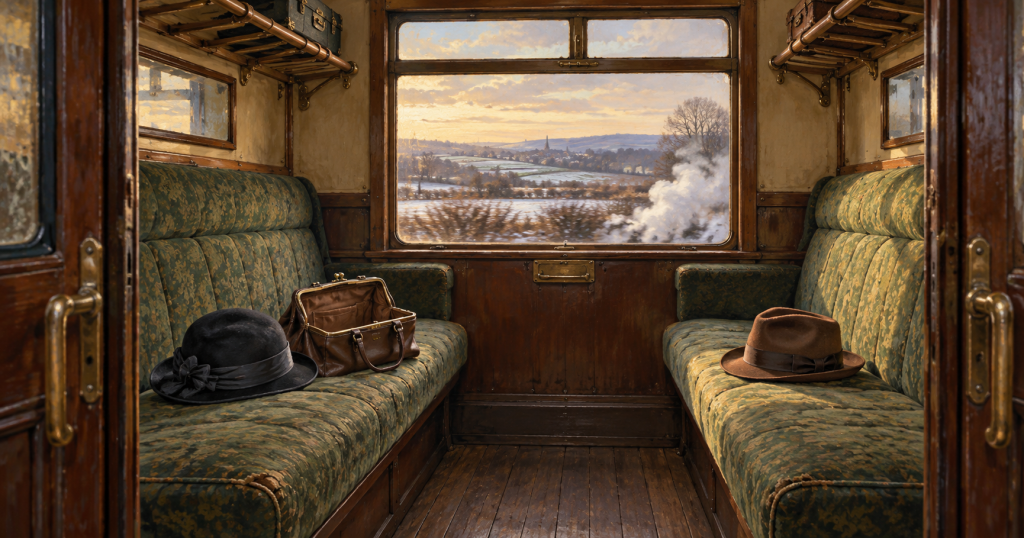
Cozy mystery authors (yes, especially me!) love a locked room. A body, a door no one could have opened, and a reader turning pages to find out how it was done. But one of the most baffling locked-room puzzles of the 1920s wasn’t dreamed up by a novelist at all. It happened on a train to the Sussex coast, in broad daylight, and it has never been solved.
Florence Nightingale Shore was born in 1865 into a comfortable Derbyshire family. She was the goddaughter, and a distant cousin, of the Lady of the Lamp herself, and it seems she was always destined for nursing. She didn’t need to work, but she trained as a Queen’s Nurse, served in South Africa during the Boer War, and spent five years nursing in France during the Great War, where she was decorated for her bravery.
By January 1920 she was home again, in her mid-fifties, and looking forward to a quieter life.
On Monday 12 January she set off from Victoria Station to visit friends in St Leonards. Her friend and fellow nurse Mabel Rogers came to see her off, and settled her into a third-class compartment at the back of the train.
In 1920, carriages had no corridors. Each compartment was its own little room, and the only way in or out was through the door when the train stopped at a station.
Just before the train pulled away, a young man in a brown suit climbed into the compartment. Mabel noticed him. And then the train was gone.
The first stop was Lewes. The next was Polegate, where three workmen got into the same compartment and found a woman sitting in the corner, apparently fast asleep. It took them a while to realise that she wasn’t asleep at all. She had been badly beaten about the head, and she was barely alive.
There was no sign of a struggle. Her purse and jewellery were missing. And the young man in the brown suit had vanished, most likely stepping off at Lewes without anyone seeing him go.
Florence was taken to the East Sussex Hospital in Hastings. She never regained consciousness, and she died four days later, on 16 January 1920.
Scotland Yard was called in, and the famous pathologist Sir Bernard Spilsbury examined the case, just as he did in so many of the great murders of the era. The newspapers went wild for “the man in the brown suit”. Several men were questioned, and over the years all sorts of names have been suggested, from a notorious army deserter to men with links to the intelligence services.
The inquest returned a verdict of wilful murder by a person or persons unknown. More than a hundred years later, that is still all we can say for certain.
Agatha Christie certainly noticed. In 1924 she published a novel called The Man in the Brown Suit. And the story has gone on inspiring writers ever since, including a television drama that imagined Christie herself trying to solve it.
It’s easy to see why: a respectable lady travelling alone, a stranger in a brown suit, a train with nowhere to hide, and a killer who simply stepped off at the next stop and disappeared into history.
I can’t help wondering what Tommy and Evelyn would have made of it. I suspect Evelyn would have been on the next train to Lewes!
Who do you think the man in the brown suit was? I’d love to hear your theories.
Or let me know your favourite locked room mystery in the comments – I would love to know!