
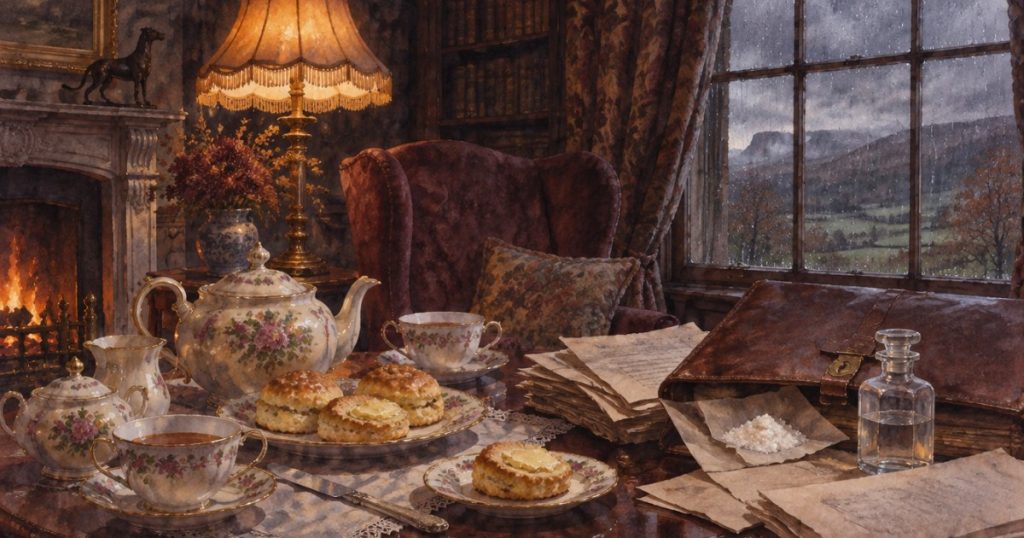
There’s nothing quite like a pot of tea and a plate of buttered scones on a dark November afternoon. Unless, of course, your host was Herbert Rowse Armstrong. If you think poisoned tea parties only happen in cosy mysteries, think again. This is one of the most extraordinary true crime cases in British history, and it has every ingredient of a classic Golden Age whodunnit.
A Respectable Man in Hay-on-Wye
In the quiet market town of Hay-on-Wye, on the border between England and Wales, Herbert Rowse Armstrong seemed the very picture of respectability. He ran a law firm in the town, served as clerk to the local magistrates, and had come back from the war with the rank of Major, a title he was happy to keep using. He was the sort of man a 1920s village would trust with its wills, its property and its secrets.
But behind closed doors, Armstrong had a secret of his own—and, as it turned out, a pocket full of arsenic.
In February 1921, his wife Katharine died, aged 48. She had been unwell for months, and at the time nobody thought to question it.
“’Scuse Fingers”: Afternoon Tea with a Rival
Then Armstrong turned his attention to Oswald Martin, the only other solicitor in Hay. The two men were on opposite sides of a property sale, and if it went against Armstrong, his client stood to owe Martin’s firm a great deal of money.
On 26 October 1921, Armstrong invited Martin to his home, Mayfield, for tea. He picked up a buttered scone, said the now-infamous words “’scuse fingers”, and handed it across the table. Martin ate it. That evening, he was violently ill.
It wasn’t the first odd thing to happen to the Martins. Before the tea party, an anonymous box of chocolates had arrived at their house—and at least one of them had a tiny hole in its base and arsenic inside. Even more unfortunately for Armstrong, Martin’s father-in-law, John Davies, was the local chemist. He was the very man who had been selling Armstrong arsenic, supposedly to kill the dandelions in his garden. In autumn. When there were, by later accounts, only about twenty dandelions at Mayfield to kill.
Martin’s doctor raised the alarm and Scotland Yard became involved. Meanwhile, Armstrong kept inviting Martin back for more tea.
Arrest, Exhumation and Trial
Armstrong was arrested on New Year’s Eve 1921, at first for the attempted murder of Oswald Martin. When the police searched him, they found a small packet of arsenic in his pocket, and plenty more at his house.
Katharine Armstrong’s body was exhumed and examined by the Home Office pathologist Bernard Spilsbury, and arsenic was found. In January 1922, Armstrong was charged with his wife’s murder.
His trial opened at Hereford on 3 April 1922 before Mr Justice Darling, and on 13 April the jury found him guilty. His appeal failed, and he was hanged at Gloucester Prison on 31 May 1922, still maintaining his innocence.
Herbert Rowse Armstrong holds a grim distinction in British legal history: he remains the only solicitor in the UK ever hanged for murder.
Why the Hay Poisoner Still Fascinates Crime Writers
The case caused a sensation at the time and has fascinated readers ever since. George Orwell included it in his 1946 essay Decline of the English Murder, and it’s easy to see why crime writers of the Golden Age loved it. A small rural community, a respectable professional hiding a terrible secret, poison served at afternoon tea, and the local chemist with a careful record of who bought what. It could be the plot of an Agatha Christie novel—and it sounds very much like something I might write myself.
In fact, if Tommy and Evelyn had been taking tea in Hay-on-Wye that autumn, I suspect they’d have had quite a lot to say about the solicitor with the scones…
If you’d like to read more about the case, the Wikipedia article on Herbert Rowse Armstrong is a good place to start.
What do you think—could you have spotted the Hay Poisoner? I’d love to hear your thoughts in the comments.