
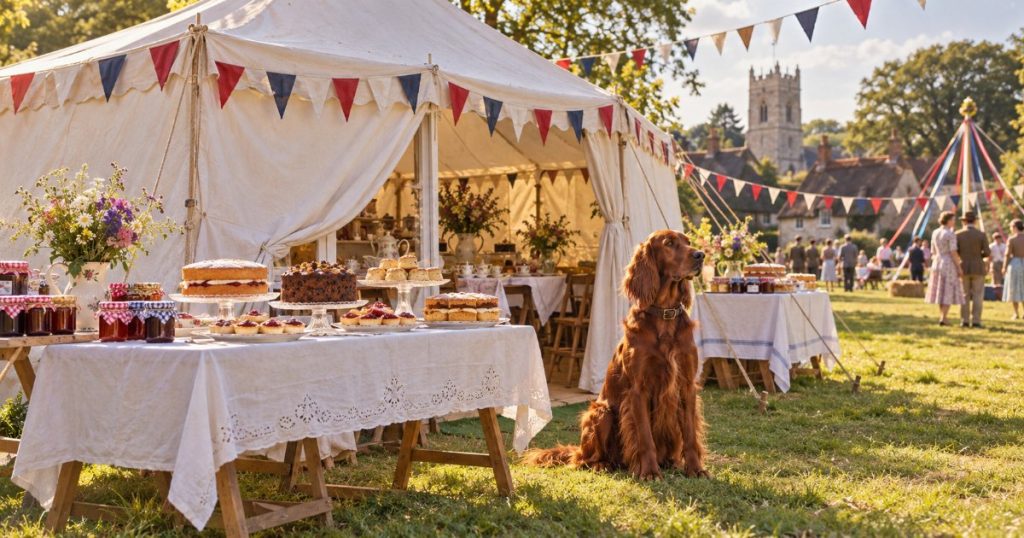
There’s a particular kind of September afternoon that belongs to the English village fair. Bunting strung across the green, a white marquee with its flaps tied back, and trestle tables crowded with Victoria sponges, jam tarts and jars of home-made jam. Somebody’s dog has been entered in the dog show. Somebody else is quietly certain their fruit cake will take first prize.
It’s about as cosy as English village life gets – which is exactly why I couldn’t resist putting a body behind the tea tent.
This post contains affiliate links, so I may earn a small commission if you buy through them, at no extra cost to you.
The end of summer, 1947
Daggers at the Country Fair is set in September 1947, in the Berkshire village of Winteringham, a short bus ride from Martha Miller’s home in Westleham. The war has been over for two years, but rationing hasn’t. In fact, bread was rationed after the war, which it never had been during it. People were still making do and mending, and saving a tin of fruit for a special occasion.
So a country fair mattered. In the book, the Winteringham and District Country Fair is the biggest day in Berkshire’s social calendar. It’s held on the first weekend of September and marks the end of summer. For a village still finding its feet, a day of pony rides, sideshows and home baking is a promise that ordinary life is finally coming back.
What a village fair looked like
Fairs like this were built by the village, for the village. The committee roped off the green, the local farmer brought his ponies for rides, and anyone who could bake filled the cake stalls. There was always a tea tent, because no English event can run without tea, and there was a guest of honour to cut the ribbon. Traditionally, that meant the local gentry.
Not in Winteringham. The fair’s chairwoman, Annie Raynor, is one of my favourite characters to write. She’s taller than most men, organised to within an inch of her life, and determined to prove the men of the village wrong. So she invites Martha, rather than the Earl, to open the fair. Martha, who would much rather be pottering in her cottage garden, finds herself in front of a crowd with a pair of fabric shears in her hand.
Annie has even put up a maypole, in September. Whether that’s a stroke of genius or a step too far, I’ll leave you to decide.
Why a fair is the perfect crime scene
At a village fair, everyone is there and everyone is busy. Stallholders are counting change, children are queuing for pony rides, and the whole village is drifting between the cake stalls and the tea tent. Who would notice if someone slipped away for ten minutes? Who would hear anything over all the chatter?
It’s Lizzie, Martha’s faithful red setter, who senses something is wrong before anyone else does. Behind the tea tent lies Helen Kennedy, the vicar’s beautiful teenage niece, and she has been stabbed. Martha and Luke Walker soon discover that, in a village this small, nearly everyone has a secret they would rather keep.
I won’t say any more than that. But if you’ve ever looked around a village fete and wondered what your neighbours were really thinking, this one is for you.
Come to the fair
Daggers at the Country Fair is the second Martha Miller mystery. You can read it on its own, though if you’d like to meet Martha from the very beginning, start with Poison at the Village Show.
Did you have a village fair or fete when you were growing up? What was the best thing on the cake stall? I’d love to hear about it in the comments.