
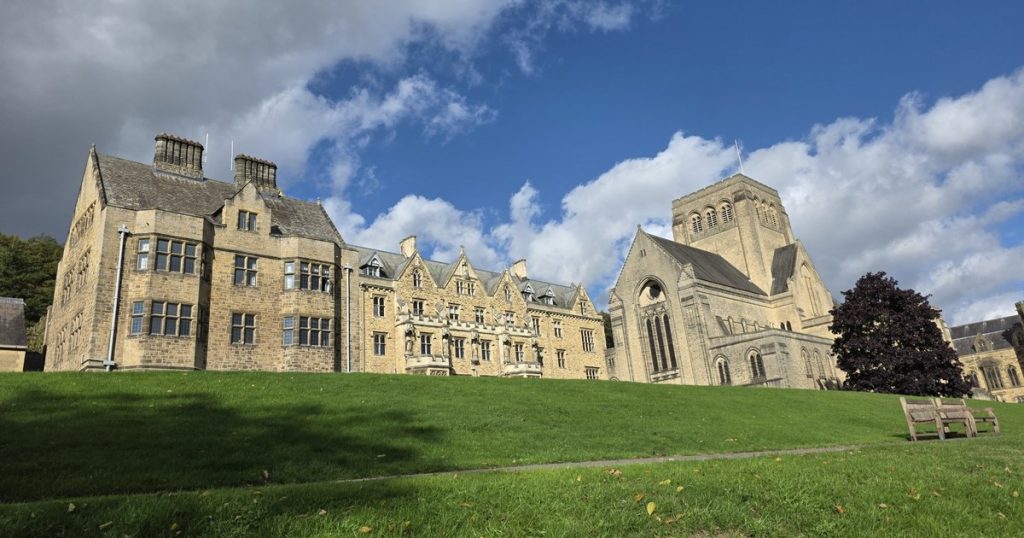
From researching my family history, I know that members of my family lived around Ampleforth, a little village in the hills of North Yorkshire, over a hundred years ago. The first time I visited the area, I felt drawn to it straight away.
These days, a few of us cozy mystery writers pack up our notebooks and head to Ampleforth Abbey for writing retreats. We love it so much that we now go twice a year, and next year some of us are going three times.
It’s so peaceful and lovely there that going back feels like coming home. Whether that’s down to how the place makes me feel, or to the family who lived there all those years ago, I don’t know.
Which makes it slightly awkward that we spend our time there plotting murders! We are all cozy mystery authors, after all.
This post contains affiliate links, so I may earn a small commission if you buy through them, at no extra cost to you.
A poison with a monk’s name

Last year at Ampleforth, I wrote Murder on the Cricket Green, the fourth Martha Miller mystery. It’s set in May 1948, on the day of Westleham’s first village cricket match since the war, and the poison at the heart of it is monkshood.
Monkshood gets its name from its flowers. Each one has a hood at the top, just like the cowl on a monk’s habit. It’s a beautiful plant, deep purple and often grown in old cottage gardens, and every part of it is deadly.
I didn’t realise the irony until I was sitting there writing about it, with the monks going about their quiet day just outside the window. I promise they had nothing to do with it.
The monks who came home

The monks at Ampleforth have a remarkable history. When Henry VIII dissolved the monasteries, England’s Benedictine monks were scattered. By 1607 only one monk from Westminster Abbey was still alive, Fr Sigebert Buckley. Before he died, he passed the old English Benedictine line on to a group of English monks living in exile. Ampleforth’s community descends directly from them.
Those monks spent almost two hundred years in France, at Dieulouard near Nancy. Some secretly crossed back to England to serve as priests at a time when Catholic worship was against the law. In 1792 the French Revolution drove them out, and in 1802 they settled at Ampleforth. They have been there ever since. The school opened a year later, and the community became an abbey in 1900.
Hunting for mice
If you visit, keep your eyes peeled for mice. Not real ones, but carved ones.
Robert Thompson, the “Mouseman”, was a woodcarver from Kilburn, just down the road. The story goes that he was working on a church carving when a colleague joked about being as poor as a church mouse, so Thompson carved a mouse on the spot. It became his trademark.
Ampleforth has one of the largest Mouseman collections anywhere. There are mice on the choir stalls, the pews and the Abbot’s stall, all through the library, and even hidden on the little tip-up seats in the choir. Finding them all is a lovely game in between writing sessions.
And if you visit in the autumn, the monks’ orchard is worth a wander. They’ve grown apples at Ampleforth for more than two hundred years, and they still press their own cider.
Have you been?
Have you ever visited Ampleforth, or spotted a Mouseman mouse somewhere? I’d love to hear about it in the comments.
Murder on the Cricket Green is book four in the Martha Miller Mysteries. Although you can read it now, it’s best read as part of the series. Just as a reminder, the Martha Miller books (published by Boldwood Books) are all in Kindle Unlimited, and they are also available on all platforms.